|
|
MBABANE INFORMATION AND HISTORY
|
||||||||||||
Location of Mbabane in eSwatini (Swaziland).GPS : 26°19′S 31°08′E
Mbabane was founded in the late 1880s by Mickey Wells.
In 1903 Mbabane was recognized by the British as the capital town of eSwatini (Swaziland).
One of the main streets found in the capital is known as the Gwamile Street which was found by Allister Miller in 1864. Mbabane is the country’s executive capital where most of the government offices are circulated. Mbabane is situated in the highveld of the country and it encompasses a moderate temperature.
Mababane has a variety of tourist attractions, including luxurious B&B accommodation, guest houses, hotels and lodges. A wide variety of shops, supermarkets, chemists, restaurants, golf course and clubs art galleries and banks and multiple ATMs can be found at the Mall and at the Swazi Plaza. Mbabane market is one of the places in Mbabane which caters a variety of arts, crafts, fruits and vegetables.
With an estimated population of 95,000 (2007), Mababane is the capital and largest city of eSwatini (Swaziland).
It is located on the Mbabane River and its tributary the Polinjane River in the Mdimba Mountains.
It is located in the district of Hhohho, of which it is also the capital. The average elevation of the city is 3,800 ft.
The town grew after the nation's administrative centre moved from Bremersdorp (now called Manzini) in 1902. It derives its name from a Chief, Mbabane Kunene, who lived in the area when British settlers arrived.
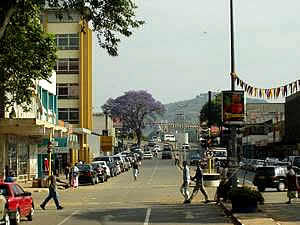
It is also a commercial hub for the surrounding region, while tin and iron were mined nearby. View of MbabaneMbabane's closest border crossing to South Africa is Ngwenya-Oshoek, and though siSwati is the primary language, English is widespread. Mbabane, and eSwatini (Swaziland) itself, depend on tourism and sugar exports.
The city has two sites for light industries. Mbabane is the home of the Waterford-KaMhlaba United World College of Southern Africa, as well as one of the three campuses of the University of eSwatini (Swaziland).
Also in Mbabane is the British High Commission which is responsible for relations between the governments of eSwatini (Swaziland) and the United Kingdom.
CLIMATE
Due to its altitude, Mbabane features a milder, more moderate form of a humid subtropical climate. The city has a mild climate and snow is a rare event, which occurs once or twice in a decade. The city averages only four days of frost a year. The average annual temperature is 15°C in July and 22°C in January [2]. http://en.wikipedia.org/wiki/Mbabane
The average temperatures at Mbabane, according to seasons
|
|
|||||||||||||||